Coral vs. the Claude and Codex desktop apps: what’s different
How three ways to run AI coding agents compare once you run more than one: the Claude desktop app, the Codex desktop app and Coral.
The Claude desktop app (its Code tab) and the Codex desktop app both put coding agents in a window on your computer. Coral is a different kind of tool: it starts the agent command-line tools for you and adds a team layer on top. This post compares the three on what matters when several agents work at once.
Coming from one of the apps? There are guides for moving from the Claude desktop app and moving from the Codex desktop app.
OpenAI now documents the Codex app inside the ChatGPT desktop app, as its Codex mode. When we say “the Codex app” we mean that mode.
The tools at a glance
| Coral | Claude desktop app | Codex desktop app | |
|---|---|---|---|
| What it is | Team platform: structured tasks, reviews, artifacts and an operator inbox | Window for Claude Code sessions (the Code tab), with a preview pane and pull-request tools | Window for Codex threads, with a diff pane, scheduled tasks and pull-request buttons |
| Agents it runs | Claude Code, Codex, Antigravity CLI and Pi, started as command-line tools you install and sign in to yourself | Claude Code | Codex |
| Licence | Apache-2.0 | We did not audit the app’s licence | We did not audit the app’s licence |
| Platforms | macOS and Windows desktop app; Linux as server and browser dashboard | macOS, Windows, Linux (beta) | macOS, Windows, Linux |
| Needs | Git, an agent tool installed and signed in; tmux on Linux | A Pro, Max, Ultra, Team or Enterprise plan; Git for Windows on Windows | A ChatGPT sign-in; plan requirements not confirmed from the pages we read |
| Runs where | Your own computers | Local, cloud, SSH or WSL | Local checkout or worktree; cloud not confirmed for the app |
Checked Nov 9, 2026: Coral, LICENSE and quickstart; Claude, Claude Code Desktop and quickstart; Codex, OpenAI’s app and features pages.
Parallel work: how do agents stay out of each other’s way?
- Coral has a shared checkout mode, a worktrees mode where each agent gets its own worktree and branch, and a merge queue mode for when one person or role lands everyone’s patches.
- The Claude app runs sessions in parallel and can give each one a Git worktree (off by default), stored under
.claude/worktrees/in your project. Archived worktrees are removed about 30 days later, and archiving can discard uncommitted changes. - The Codex app offers Local or Worktree threads, and a hand-off button that moves a thread between them. It keeps your 15 most recent managed worktrees and deletes older ones, saving a snapshot first.
Coral: teams and tasks, merge queue. Checked Nov 9, 2026: Anthropic, Claude Code Desktop; OpenAI, Git worktrees.
Agent teams: how do agents coordinate?
- Coral has named roles, a shared message board, a task queue with priorities and dependencies, goals, health monitoring and cross-team messaging. Teams persist: you can put a team to sleep and wake it later.
- The Claude app lets Claude list and message your other local, SSH and WSL sessions, one session at a time. It cannot see cloud sessions or sessions started in a terminal. Anthropic’s agent teams, with a lead, teammates and a shared task list, are experimental, off by default and, per the docs, available in the command line and not in the desktop app.
- The Codex app pages we read describe no multi-agent coordination and no shared task list. The Codex command-line changelog mentions an agent command center that we did not audit.
Coral: teams, board. Checked Nov 9, 2026: Anthropic, Claude Code Desktop, agent teams; OpenAI, features.
Operator inbox: who is waiting on you?
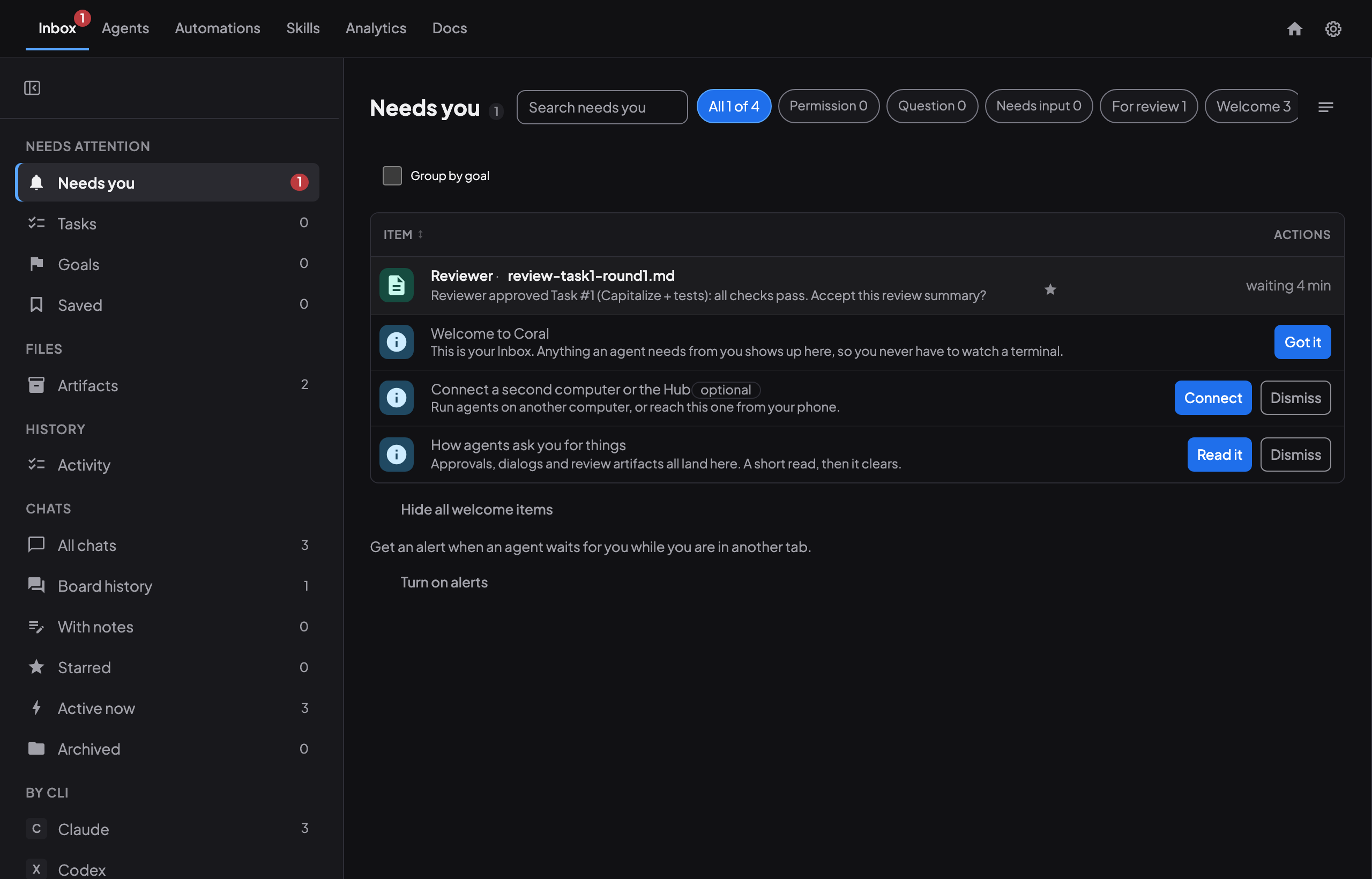
- Coral has a dedicated “Needs you” inbox. Agents post questions and submit work for review, and a health monitor escalates idle agents and stale waits. A failed scheduled job appears there too.
- The Claude app sends an operating-system notification when a session finishes and you are not looking at it. It has no separate cross-session inbox in the docs we read.
- The Codex app lets you approve or decline a request from the keyboard, shows scheduled-task results in a Scheduled view, and its phone view lets you approve actions. We found no cross-thread inbox in the pages we read.
Coral: board, using the dashboard. Checked Nov 9, 2026: Claude Code Desktop; OpenAI, commands, scheduled tasks.
Review workflows: who checks the agents’ work?
- Coral has multi-round reviews: an agent submits work, the orchestrator delegates to reviewers, who approve or reject with comments. Verification badges show whether work was verified, backed by evidence or unverified. It also has a built-in diff viewer.
- The Claude app has a diff view where you comment on lines and send the comments back, a
/code-reviewcommand that offers to walk through the diff or apply fixes, and pull-request monitoring with auto-fix and merge-when-ready (it needs the GitHub command-line tool). - The Codex app has a diff pane with inline comments that Codex can address, lets you stage or revert chunks, commit, push and open a pull request in the app.
Coral: completion review. Checked Nov 9, 2026: Claude Code Desktop; OpenAI, local environments.
Artifacts and preview: what did the agents produce?
- Coral has an immutable, content-addressed artifact store. Each artifact gets a SHA-256 hash and a
coral://address. People and agents can comment on text artifacts, search, filter by tag and share across teams, and Coral previews images, audio and video, text, Markdown, HTML and JSON. - The Claude app has a Browser pane that starts your dev server, shows the running app and checks changes after edits. It is not an artifact store.
- The Codex app pages we read describe no artifact store.
Coral: files and artifacts, artifacts. Checked Nov 9, 2026: Claude Code Desktop; OpenAI, features.
Scheduled work
- Coral has scheduled jobs: a five-field cron expression and time zone, a prompt job or a saved workflow, a time limit, and optional worktree clean-up. The Coral docs we read do not say whether a missed run is made up.
- The Claude app has local scheduled tasks (hourly, daily, weekdays, weekly, or a custom cron no more frequent than hourly) that fire only while the app is open and your computer is awake, with one catch-up for a recent missed run. Cloud routines run when your computer is off.
- The Codex app has scheduled tasks with RRULE schedules that start a new thread for each run and need the computer on and the app running when they use local files.
Coral: scheduled jobs. Checked Nov 9, 2026: Anthropic, scheduled tasks; OpenAI, scheduled tasks.
Setup and getting started
- Claude app: install the app, sign in with a paid plan, open the Code tab and pick a folder. No separate command-line install. The fastest path to a running agent (our assessment). Quickstart
- Codex app: install the app, sign in with your ChatGPT account and open a project. Also quick (our assessment). App overview
- Coral: install the app, install and sign in to at least one agent command-line tool, open Coral and create a team. The team builder helps, but there are more steps than in either app (our assessment). Quickstart
Checked Nov 9, 2026.
Mobile and remote access
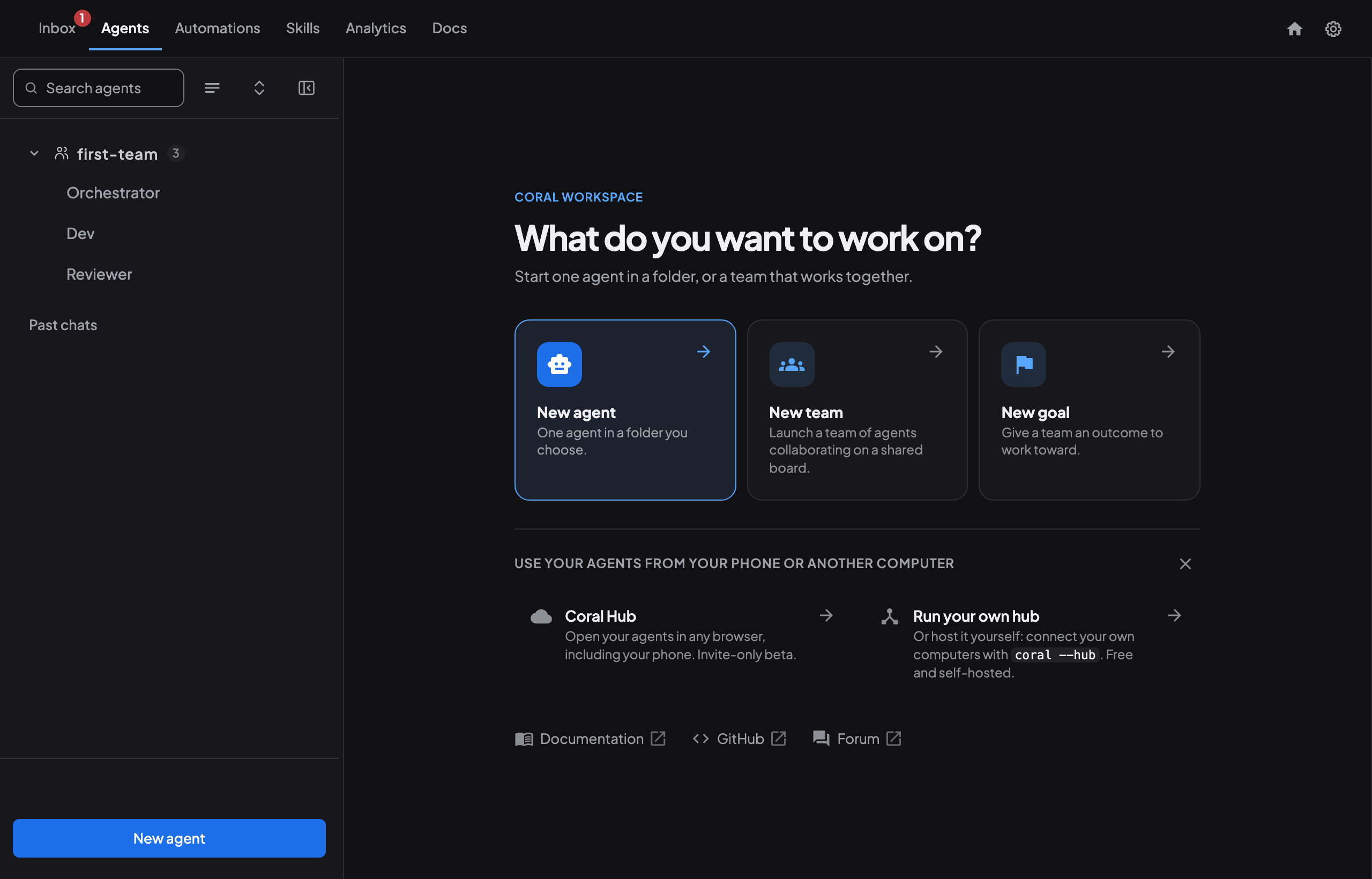
- Coral has Coral Hub, which shows your agents on a phone or any browser (closed beta), and you can run your own hub. Direct remote access to a computer’s dashboard, for example by QR code on your network, is off until you turn it on and restart.
- The Claude app sessions can be controlled from claude.ai/code and the Claude mobile apps through Remote Control, and cloud sessions can be watched there too.
- The Codex app has a phone view to start tasks, approve actions and review work; the work runs on a connected computer or remote environment, not on the phone.
Coral: remote access. Checked Nov 9, 2026: Claude Code Desktop; OpenAI, features and worktrees.
Side by side
| Capability | Coral | Claude desktop app | Codex desktop app |
|---|---|---|---|
| Several agents at once | Yes, as a team | Yes, as parallel sessions | Yes, as threads |
| Worktree isolation | Worktrees mode | Per-session toggle | Worktree threads |
| Roles and shared task queue | Yes | No in the app; agent teams are experimental in the command line | Not described in the pages we read |
| Messaging between agents | Message board | Between local, SSH and WSL sessions | Not described |
| Operator inbox | Yes (“Needs you”) | Notifications; no inbox described | Approvals and a Scheduled view; no inbox described |
| Review workflows | Multi-round, delegated; diff viewer | Diff comments, /code-review, PR auto-fix | Diff comments, commit, push and pull request |
| Artifact store | Yes | No (Browser pane preview) | Not described |
| Scheduled work | Cron jobs and workflows | Local tasks; cloud routines | Scheduled tasks |
| Runs several agent tools | Yes: Claude Code, Codex, Antigravity, Pi | Claude Code only | Codex only |
| Cloud execution | No; your computers | Yes (cloud sessions) | Not confirmed for the app |
| Phone | Coral Hub (closed beta); remote access | Claude mobile app | Phone view |
| Open source | Yes (Apache-2.0) | Not audited | Not audited |
Which tool fits?
- One person, a few sessions, a polished window. The Claude app if you work with Claude Code, with its preview pane and pull-request tools, or the Codex app if you work with Codex. Both are quick to set up.
- Agents that work as a team, with roles, a task queue, reviews, an inbox, artifacts, teams that survive restarts, and a mix of agent tools: that is what Coral is built for.
- Cloud sessions that run while your computer is off. The Claude app has them; Coral runs on your own computers.
- Both. The apps and Coral do not exclude each other. Coral starts the same command-line tools, so you can keep an app for solo work.
Items marked “our assessment” are our judgement, not sourced facts. “Not described” means the pages we read do not mention the feature; the app may offer it. We read each app’s own documentation, not the apps themselves. We make Coral, so read this comparison with that in mind, and tell us where we got a tool wrong. We have no commercial relationship with Anthropic or OpenAI. Claude, Claude Code, Codex, ChatGPT and other product names are trademarks of their owners; no endorsement is implied.
Sources
- Anthropic documentation, checked Nov 9, 2026: Claude Code Desktop, quickstart, scheduled tasks, agent teams.
- OpenAI documentation, checked Nov 9, 2026: app, features, Git worktrees, local environments, scheduled tasks, commands.
- Coral: the agent docs, the published docs and the LICENSE.