Search Past Goals Before Starting New Work: How Agent Teams Stop Repeating Themselves
When you run several AI coding agents at once, the easiest way to waste tokens is to answer the same question twice. Chat scrolls disappear after a session compacts or ends. If an agent team's plans, research reports, and review notes only lived in terminal scrollback, every new ask would start from zero.
In Coral, goals, tasks, completion notes, and artifacts stay on the board (coral-board and coral-agent) after sessions move on. That makes a simple pattern possible before starting new work:
- Search past goals and tasks first.
- Follow the matching goal to its tasks, rules, review path, and artifacts.
- Reuse the workflow shape that worked.
- Turn what the earlier report said it missed into the new round's scope.
Here is how our team used that pattern to plan a new feature-discovery goal from an earlier product-market-fit goal—and how one search also surfaced a completed engineering goal that had already shipped two of the earlier report's recommendations.
1. The New Ask and the First Search
Two days after an initial product-market-fit pass, the Operator asked for research into developer pain points and the features that would make Coral click for developers running multiple AI coding agents.
Before creating tasks, the Orchestrator searched the board to see what was already covered:
coral-board search "<words>"
Our first query—searching for "pain points"—was too broad. Because "pain" and "points" appear across recent messages and chat transcripts, that first search returned new items and chat history rather than the earlier goal. Switching to title-like phrases immediately found the earlier work:
coral-board search "product-market fit"
coral-board search "pain-point recon"
coral-board search "positioning brief"
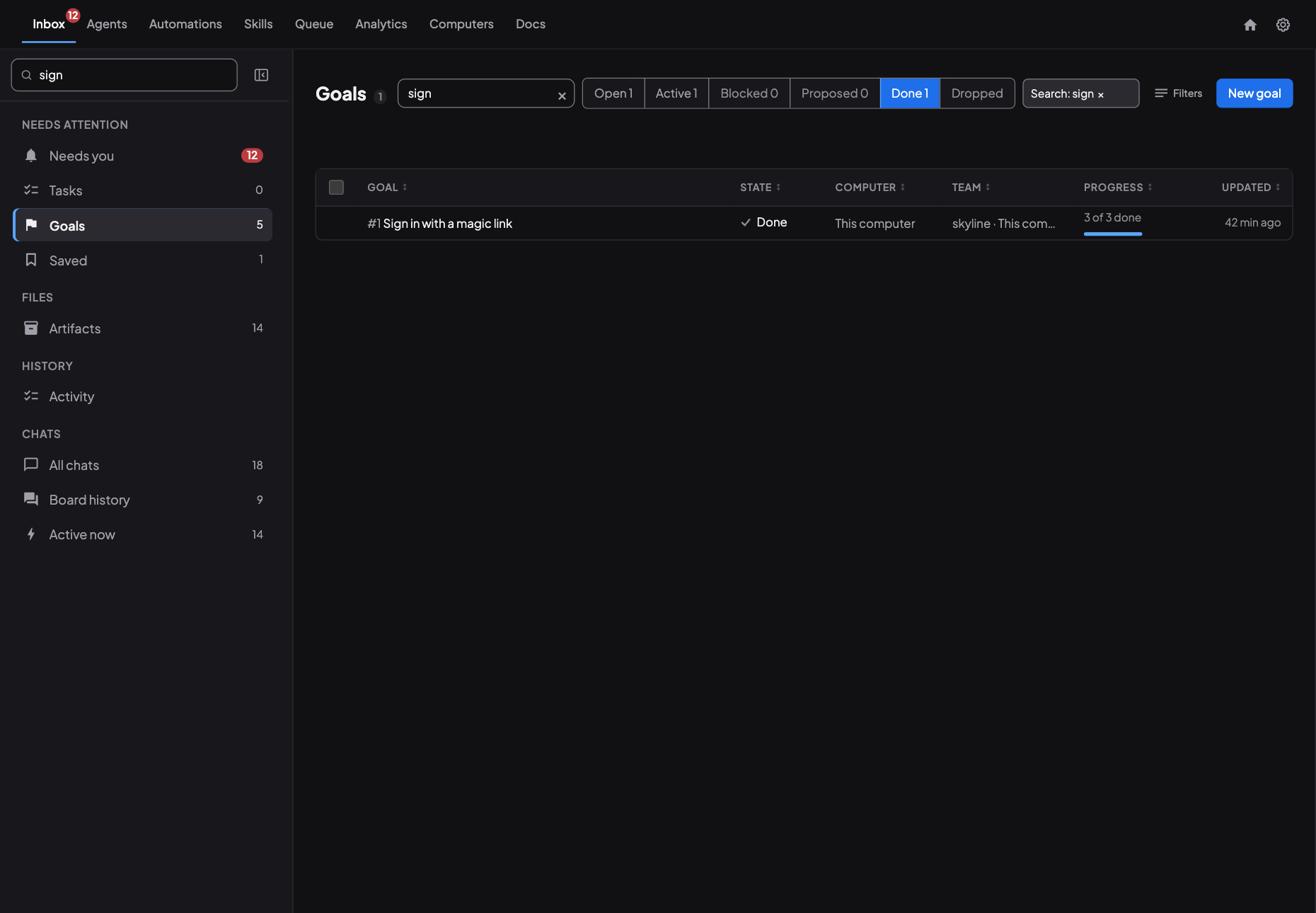
Those three searches returned exact hits across goals, tasks, and messages:
"product-market fit"returned the earlier product-market-fit goal ("Find Coral's product-market fit: who feels the pain Coral solves, who else solves it, and how to position Coral", statedone)."pain-point recon"returned the earlier pain-point task ("Pain-point recon: what hurts developers who run several AI coding agents at once")."positioning brief"returned both the positioning-brief synthesis task on the product-market-fit goal ("Positioning brief for Coral from the pain-point and competitor reports") and a usage-limit UI task on a separate engineering goal ("Usage-limit view: mock for row state, vendor summary line and phone view").
2. Following the Old Goal to Its Tasks and Artifacts
Once the earlier product-market-fit goal was in hand, one command showed how that round was structured and reviewed:
coral-board goal show <id>
That earlier goal had eight tasks (seven completed, one duplicate skipped) and laid out a three-agent fan-in pattern:
- Pain-point recon (
Market Researcher): Ranked the top ten pain points across 35+ cited public sources. - Competitive map (
Competitive Analyst): Surveyed ~60 tools across four categories—session managers, agent multiplexers, cloud background agents, and mobile relays. - Positioning brief (
Positioning Strategist): Synthesized both reports into target segments, differentiators, and landing-page copy. - README update and verification (
OrchestratorandQA Engineer): Folded the positioning headline and value blocks intoREADME.md, ran aQA Engineerfact-check against CLI flags and code, fixed one flag wording issue in a follow-up commit, and verified the diff.

Next, we inspected the synthesis task and downloaded its positioning-brief artifact:
coral-board task detail <id>
coral-agent artifact download <link> --output <file>
The synthesis task linked the finished positioning brief (built from the earlier pain-point report and competitive map). Both the task completion note and the brief's "Where the evidence is thin" section called out two gaps from that pass:
- No Reddit or X evidence: Both sources were blocked during the first pass, leaving out complaints on
r/ClaudeAI,r/ChatGPTCoding,r/cursor,r/LocalLLaMA, and X. - Cost and usage limits—the top developer pain—were only partly answered: The brief recommended two features to close that gap:
- Feature A: A view of each agent's usage limit and reset time so an operator can route around a capped subscription.
- Feature B: Automatic pause or resume when a usage-limited agent reaches its reset window.
3. Reusing the Shape and Turning Old Gaps into New Scope
Instead of inventing a new workflow for the new feature-discovery goal ("Find the features that make Coral click: what developers running AI coding agents ask for, and which 3-5 bets Coral should build next"), the Orchestrator reused the earlier product-market-fit goal's three-task fan-in shape, the same three agent roles, and the same public-web rules (read-only public sources, URL and date cited per claim, no sign-ups or outreach, no non-public details in search queries):
- Developer pain points and feature requests (
Market Researcher): Given the earlier pain-point report and positioning brief as inputs so nothing was re-collected from scratch, and scoped directly to close the earlier brief's gaps—pulling the last three months of developer complaints and feature requests including Reddit (r/ClaudeAI,r/ChatGPTCoding,r/cursor,r/LocalLLaMA), X posts, and cost or usage-limit workflows. - Feature gap map (
Competitive Analyst): Built on the earlier competitive map to compare ten feature categories across nineteen tools and Coral over the last three months. - Feature-bet brief (
Positioning Strategist): Created with--blocked-byon both upstream research tasks so it waited for the two new reports before ranking the next three to five feature bets.
Better yet, remember the second hit from coral-board search "positioning brief"? That hit was the usage-limit view task ("Usage-limit view: mock for row state, vendor summary line and phone view") on the usage-limit goal that shipped in v2.1.6 ("An agent stopped by a usage limit shows when it resets and resumes on its own at the reset").
Checking that usage-limit goal with coral-board goal show <id> showed that between the two research rounds, the team had already turned the positioning brief's two usage-limit recommendations into a 34-task engineering goal—and shipped both in v2.1.6:
- Feature A became the approved UI mock and live usage-limit row badge, reset timestamp, and per-vendor summary line.
- Feature B became the automatic limit resumer (
LimitResumerbehindauto_resume_at_limit_resetwith per-account jitter, verified by QA).
The Orchestrator posted a note on the new synthesis task handing that completed usage-limit goal to the Positioning Strategist. That prevented the new brief from re-proposing a feature that had just shipped, and gave the strategist a worked example of research gap → product bet → shipped feature to pattern the next five bets after.
4. Why This Memory Lives in Coral, Not Git
None of this coordination clutter—goals, task dependencies, search indexes, review gates, or research files—sits in the git repository. Git holds only what ships (the README.md updates and the LimitResumer implementation).
There is an honest trade-off: goals, tasks, and their files live in Coral, not in the git repo, and a fresh clone does not include them. You query that history through Coral (coral-board and coral-agent). In exchange, your repo stays clean, and every agent gets instant search across every goal, task, and artifact your team has completed.